Low-Effort Communication Is Rewiring Your Brain (And What to Do About It)
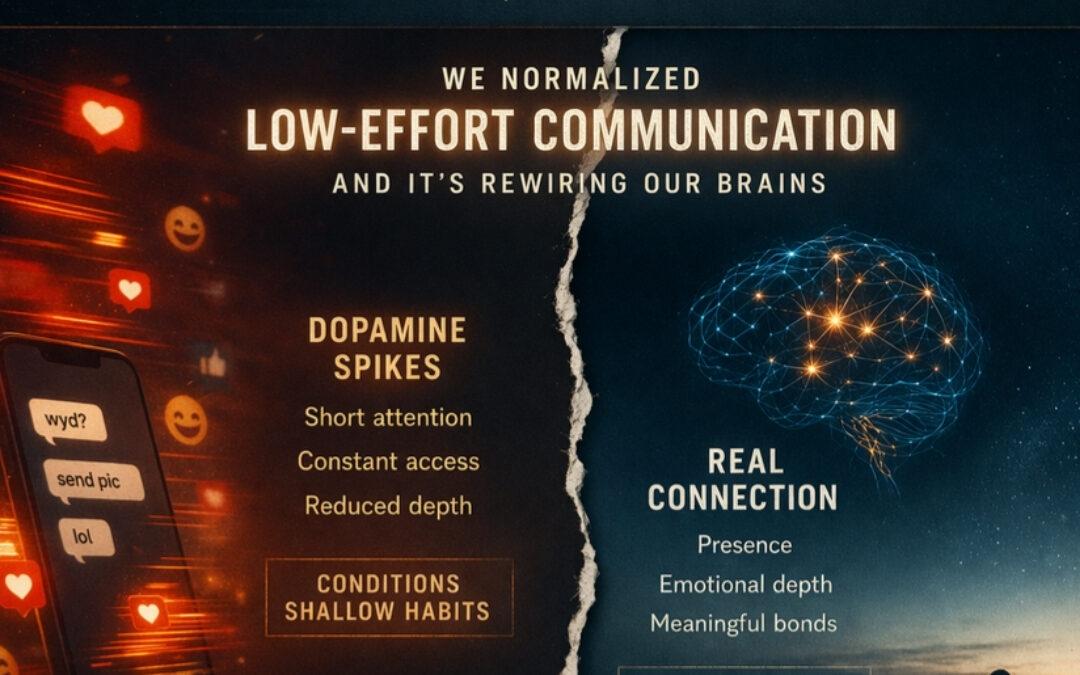
We’ve normalized low-effort communication—and it’s not just a social issue. It’s neurological. “wyd?” “lol” “send pic” These quick exchanges may seem harmless, but every short message, every notification, and every shallow interaction is training your brain to expect fast, easy dopamine instead of meaningful connection. Over time, this conditioning starts to show up in ways most people don’t immediately recognize: shorter attention spans, reduced emotional depth, difficulty staying present, and a constant need for stimulation. It feels normal, but it’s not optimal.
Low-effort communication creates dopamine spikes—quick hits of reward without effort. This leads to shorter attention loops where it becomes harder to stay engaged in deeper conversations, constant accessibility where your brain never fully rests, and reduced depth where surface-level thinking becomes your default. You’re not losing your ability to think deeply—you’re simply conditioning your brain to operate differently.
This is why real connection feels harder now. True connection requires presence, emotional engagement, time, and intentional effort. But when your brain becomes accustomed to quick dopamine hits, deeper interactions can start to feel slower, uncomfortable, or even mentally exhausting. As a result, people avoid them and default back to what feels easy. That’s the cycle.
The shift doesn’t come from trying harder—it comes from training your brain differently. At Einstein & Arnold, we focus on helping you become aware of your patterns, improve focus and regulation through brain training, strengthen decision-making through mindfulness coaching, and rebuild your ability to stay present. Better thinking leads to better decisions, and better decisions lead to better outcomes in every area of life.
You don’t need to overhaul everything at once. Start small. Pause before responding instead of reacting instantly. Replace one text conversation with a real phone call. Set boundaries with notifications so your brain has space to reset. Practice being fully present for just 10 to 15 minutes each day. This isn’t about disconnecting from the world—it’s about reconnecting with how your brain is meant to function.
“The significant problems we face cannot be solved at the same level of thinking we were at when we created them.” If your communication habits have changed your thinking, then upgrading how you think is the solution.
Take our free 2-minute brain and performance assessment to see how your brain is currently functioning: