Grand opening · Tuesday, December 29, 2026
Einstein + Arnold Calhoun
Tuesday, December 29, 2026
Inside The Lifestyle Wellness
401 Curtis Pkwy SE, Calhoun, GA

Training · Brain Map Required
Neurofeedback & Biofeedback
Guided, non-invasive training that lets your nervous system practice better patterns, calmer under stress, sharper on demand. It is not a generic protocol: what we train is decided by what your brain map shows.
Prerequisite
A brain map comes first. Always.
We do not train anyone we have not mapped. Without a qEEG there is no way to know which network is dysregulated or in which direction, and training the wrong direction makes people feel worse, not better. Get mapped, then we build the protocol.
Course of care
Map, plan, train, re-map
Neurofeedback is a course, not a drop-in service. Here is the whole sequence before you commit to it.
Brain map
A qEEG establishes your baseline. One appointment, and it is the prerequisite for everything below.
Protocol design
We read your map with you, name the training targets, and set a session count and cadence in writing.
Training block
Sessions run 2 to 3 times a week. Every session is logged, and the protocol gets adjusted as your response shows up in the data.
Re-map
The same qEEG, repeated. Your map at the end sits next to your map at the start, that comparison is the result.
The two tools
Neurofeedback and biofeedback are not the same thing
Training the central nervous system
Sensors read your brain’s activity in real time. When you drift toward a better-regulated state, the feedback rewards it, a change in sound, or a video that plays cleanly. Your brain learns to find that state on its own, the same way it learns any skill: repetition with feedback.
Nothing is sent into your head. You are not being stimulated; you are being shown what you are already doing.
Training the autonomic nervous system
The same principle applied to the body’s stress signals, heart rate variability, breathing, skin conductance, muscle tension. You watch your own physiology respond, in real time, to how you breathe and where your attention goes.
Most clients run both. Biofeedback gives you something to practice at home between neurofeedback sessions.
The states
Your brain runs at several speeds at once
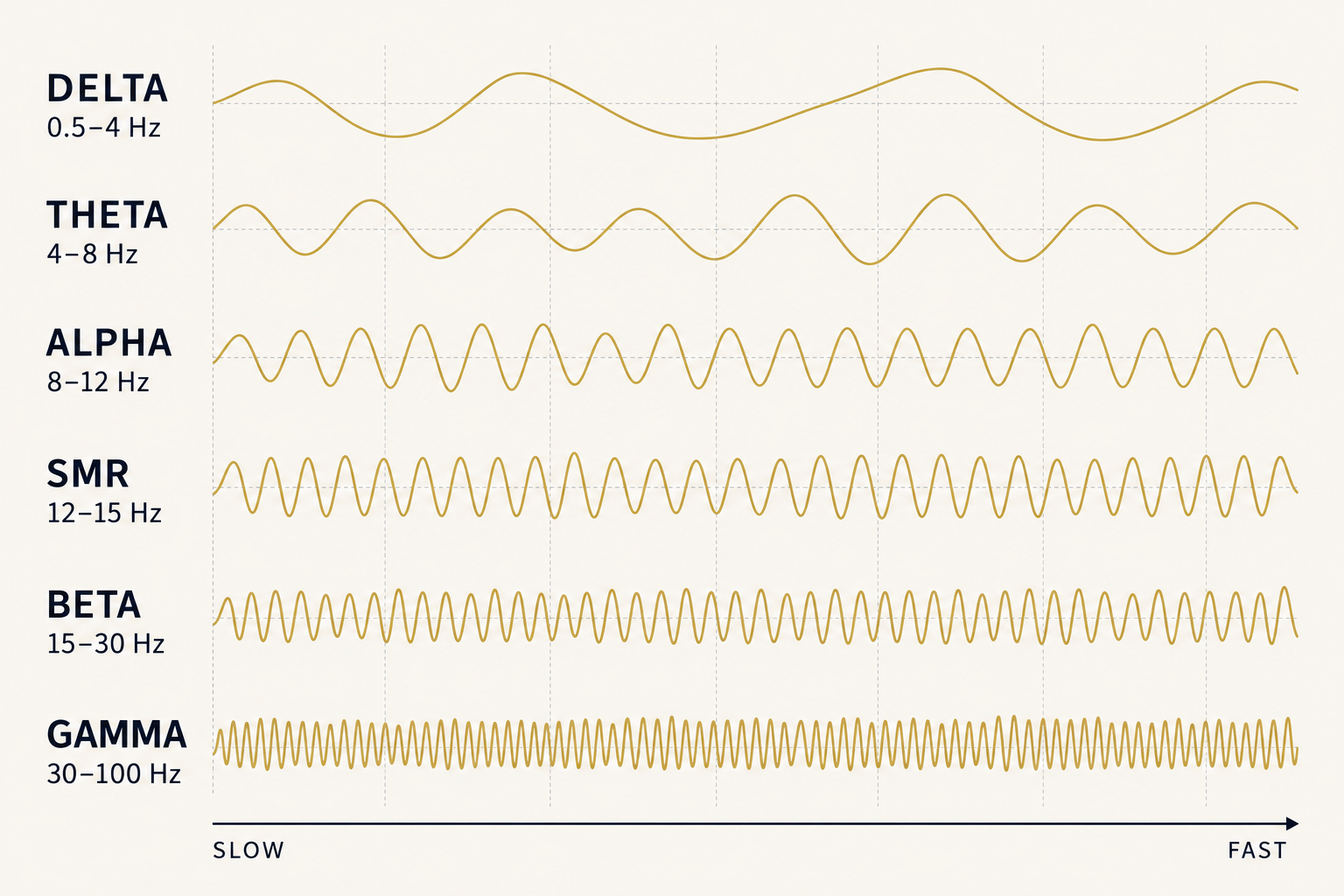
Electrical activity in the brain is measured in frequency bands. All of them are present all of the time, what matters is the mix, and whether the mix suits what you are trying to do. None of these states is good or bad on its own. Delta is exactly right at 3am and exactly wrong in a meeting.
Delta
0.5 to 4 Hz
Dominant in deep, dreamless sleep. Showing up in quantity while you are awake and alert is a finding, not a goal.
Excess waking delta often tracks with grogginess and slow processing.
Theta
4 to 8 Hz
The state between waking and sleep, daydreaming, deep internal focus, the edge of nodding off.
Excess frontal theta is one of the most common findings behind attention that will not hold.
Alpha
8 to 12 Hz
The idling rhythm. It rises when you close your eyes and drops when you engage a task.
Too little and you cannot settle. Too much in the wrong place and you cannot engage.
SMR
12 to 15 Hz
The sensorimotor rhythm, found along the strip across the top of the head. Associated with physical stillness and impulse control.
A frequent uptraining target for restlessness and for athletes who cannot switch off.
Beta
15 to 20 Hz
Working, problem-solving, holding a conversation. This is the productive end of the spectrum.
Often the uptraining target when the map shows a slow-wave excess.
High Beta
20 to 30 Hz
Useful in short bursts. Sustained, it is the signature of a nervous system that will not stand down.
A common downtraining target for people who describe themselves as wired and unable to sleep.
The zones
Where a pattern sits changes what it means
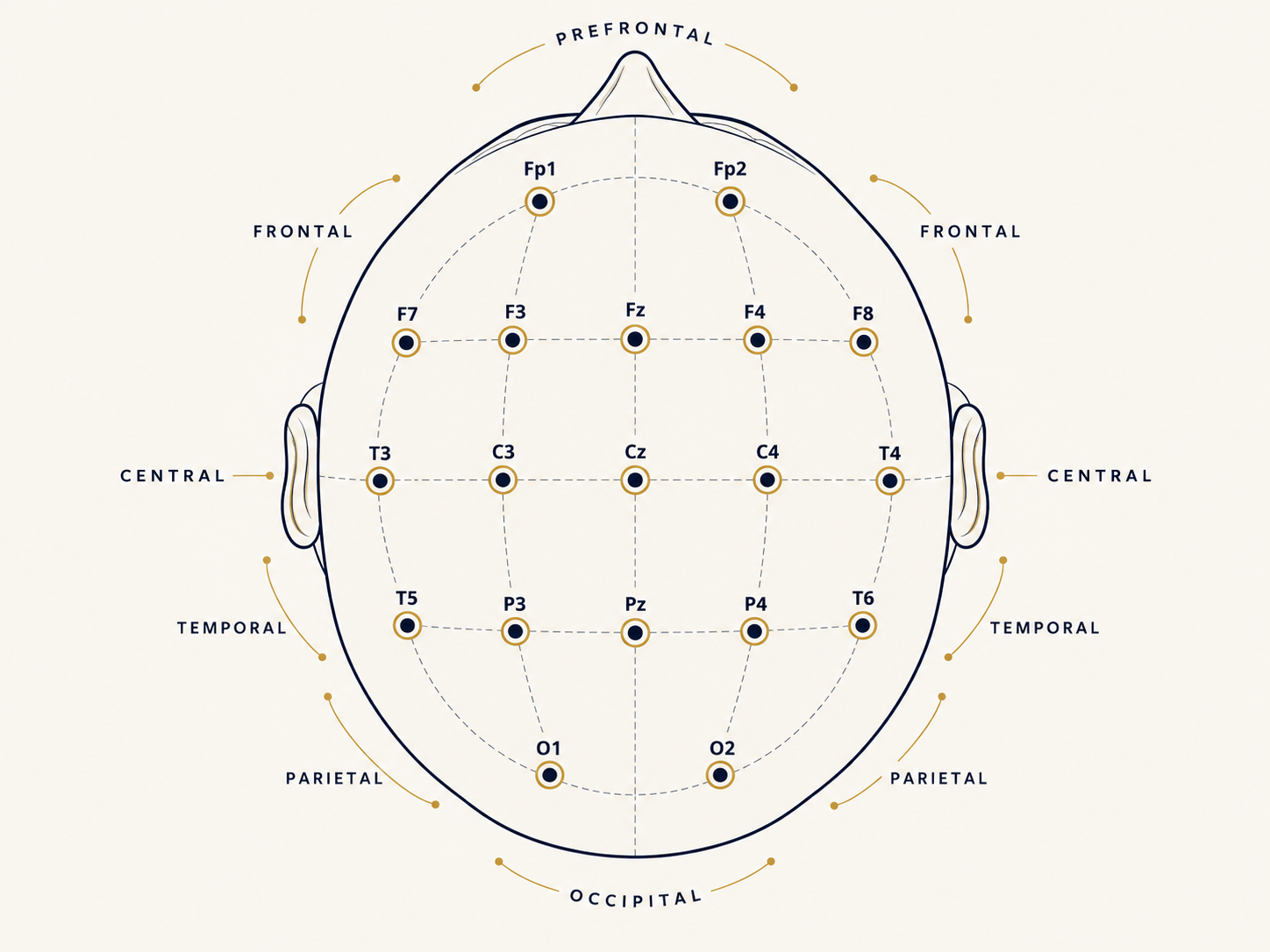
Sensors are placed at standardized positions across the scalp, and different regions do different jobs. The same excess of the same frequency means one thing at the front of the head and something else along the crown, which is why a map, rather than a symptom description, decides the protocol.
Executive control
Attention, planning, initiation, and mood regulation. The region most often implicated when someone says they cannot start tasks or cannot stay on them.
Excess theta or high beta here is the most frequent finding we train.
The sensorimotor strip
The band running across the crown, tied to motor control, physical stillness, and impulse regulation.
Where SMR lives. Uptraining here is typical for restlessness and sleep-onset problems.
Memory and emotional tone
The sides of the head, involved in memory, language, and emotional regulation.
Asymmetry between left and right here often accompanies mood and irritability complaints.
Integration
Where sensory information is assembled into something usable. Part of the attention network alongside the frontal region.
Relevant when focus is present but processing feels slow or effortful.
Visual processing
The back of the head. The main generator of alpha, which is why alpha rises so clearly when you close your eyes.
Used as a reference point for whether alpha is distributed normally.
How the decision gets made
State, plus location, plus direction
A protocol is three answers, not one: which frequency, at which site, and which way. Your map is compared against a normative database for your age, so we are looking at how your mix differs from expected, not at whether a number is high in the abstract.
Which frequency?
Usually read as a ratio rather than a raw value, how much slow activity sits against how much fast activity in the same place.
At which site?
The training electrode goes where the finding is. Frontal attention problems and central restlessness are trained in different places.
Which direction?
Uptrain to encourage more of a state, downtrain to discourage it. Getting the direction wrong is the reason unmapped training can leave someone feeling worse.
“I cannot focus.”
The map shows excess theta over the frontal region, a slow-wave pattern where engaged activity should be. She is drifting, not racing.
Protocol: downtrain theta, uptrain toward beta, frontally.
“I cannot focus.”
Identical complaint. The map shows sustained high beta frontally, a nervous system running hot and scanning. He is racing, not drifting.
Protocol: downtrain high beta, encourage calmer regulation. Close to the opposite of Client A.
Same words. Opposite plan.
Run Client A’s protocol on Client B and you make him worse. This is the entire reason we will not train anyone we have not mapped, the symptom does not tell us the direction.
On the science. Frequency bands and site functions are a working framework, not a precise map of the mind. Boundaries between bands vary between labs, and no single pattern diagnoses anything. We use this to choose a training target and then measure whether the target moved, which is the only claim we make about it.
What we train toward
Targets come from your map, not from a menu
These are the patterns we most often work on. Which of them applies to you, and in which direction, is what the qEEG decides.
Focus that holds
For attention that starts well and collapses after twenty minutes. We train the regulation that sustains it, rather than chasing stimulants.
Coming down on purpose
For nervous systems stuck in a high-arousal pattern. The training target is the return, how quickly you can leave a stress state once the stressor is gone.
Getting down and staying down
For wired-at-midnight patterns. Sleep-related rhythms show on the map, which means they can be trained and re-measured like anything else.
Resilience under load
For athletes and high-output professionals. Biofeedback does most of this work, heart rate variability is trainable and it transfers.
What a session is like
- 30 to 45 minutes in a chair, awake and comfortable
- Sensors on the scalp with conductive paste, nothing sharp, nothing sent in
- You watch or listen while the feedback does the work
- No downtime afterward. Most people drive straight back to work
Cadence & commitment
- 2 to 3 sessions a week during a training block
- Session counts are set from your map, in writing, before you start
- Consistency matters more than volume, skipped weeks cost progress
- Re-map at the end of the block, not on a marketing schedule
Honestly, who this is not for
- Anyone unwilling to be mapped first
- Anyone who cannot commit to a consistent weekly cadence
- Anyone looking for one session to fix something
- Anyone whose map shows the issue lives somewhere else, we will tell you
Training without a baseline is a guess.
Plenty of places will sell you neurofeedback sessions with no qEEG. That is a protocol chosen for the average person, and you are not the average person. Requiring the map is the single thing that makes this measurable, and it is also why we can tell you at the end whether it worked.
Educational note. Neurofeedback and biofeedback are wellness training tools. Individual experiences vary, and this is not a treatment for any medical condition. If you are managing a diagnosed condition, keep your physician involved.
Programs and pricing
Twelve weeks. Train at home, coached every week.
Every program is a 12 week commitment, built from your brain map. You train at home on your own Myndlift unit, and we coach you weekly and review your map every month.
Or $800 a month for 3 months
- Monthly brain map review
- 4 brain health and mindfulness coaching sessions a month
- Brain Training and meditation apps
- Monthly Mushroom and Shilajit gummies
- Monthly community calls with wellness experts
Or $2,149 a month for 3 months
- Monthly brain map review
- 4 brain health coaching sessions a month
- Brain Training and meditation apps
- Monthly Mushroom and Shilajit gummies
- Weekly remote sessions with a certified personal trainer
Or $1,250 a month for 3 months
- Everything in Brain Optimization coaching
- Genetic testing
- Cellular Reset with provider oversight
- Opens in Georgia once our medical provider is in place
Your home unit. Every program uses your own Myndlift device with the Brain Training and meditation apps, a one time purchase of $399 that is yours to keep. We accept HSA and FSA cards, and financing is available through AdvanceCare for those who qualify.