Grand opening · Tuesday, December 29, 2026
Einstein + Arnold Calhoun
Tuesday, December 29, 2026
Inside The Lifestyle Wellness
401 Curtis Pkwy SE, Calhoun, GA
Metabolic program · 16 weeks
The shot is not the program.
Sixteen weeks built around what your metabolic workup shows. Medication is one possible tool, chosen by your provider, never the whole plan.
The idea
Most weight loss programs fail one of three tests.
The diagnostic test: nobody asked why the weight is there. Thyroid patterns, insulin resistance and chronic inflammation are invisible on a scale and visible on the right labs. The precision test: everyone gets the same dose and the same template. The durability test: the weight comes back after the program ends.
Michael built this program from the inside. He started at 450 pounds in January 2025 and is more than 90 pounds down. It answers all three tests: testing first, a plan built on your numbers, and a durability phase that plans for life after the medication.
How it works
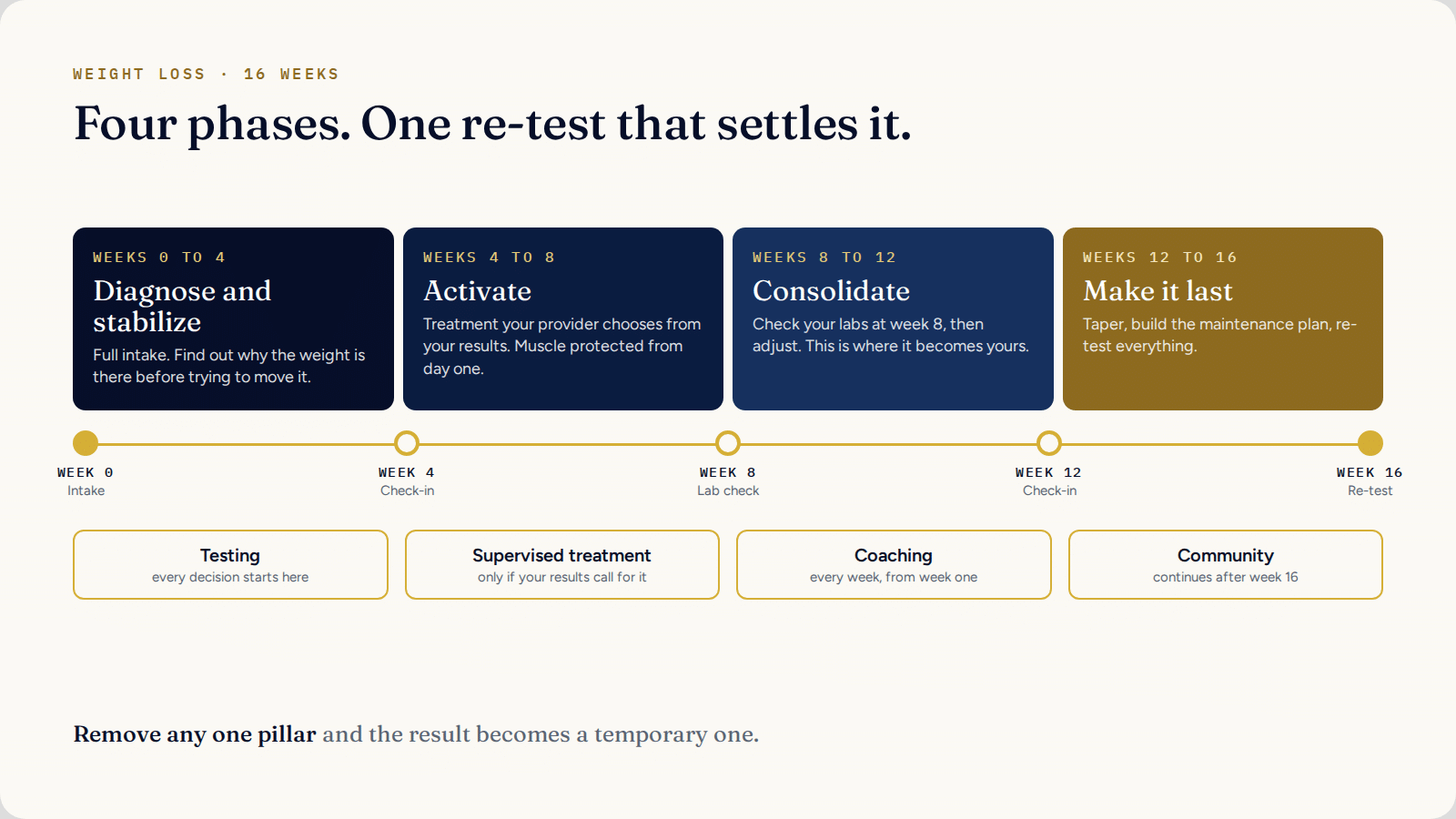
Four phases of about four weeks each
Phases run in a clinical order, not a convenient one. Your provider and coach adjust inside each one based on your numbers.
Diagnose and stabilize
The full intake runs first. The goal is understanding why the weight is there, not moving the scale yet.
Activate
If your provider decides medication fits, it starts here and is titrated. Muscle protection starts at the same time.
Consolidate
A lab check at week 8, then adjustments. This is where the program becomes yours.
Make it last
Taper, deepen the coaching, write the maintenance plan and re-test everything.
The science, in plain English
What is actually happening over sixteen weeks
Appetite signals
Prescription GLP-1 medicines mimic a gut hormone that tells your brain you are full and slows how fast your stomach empties.
The plateau is biology
Around weeks six to eight the body defends its weight by lowering energy use. Getting through that plateau is where supervision earns its keep.
Protect the muscle
Fast weight loss can take muscle with it. Protein and resistance training are how you lose fat and keep the engine.
What the research suggests
What we know, and how well we know it
Prescription medicines work
In STEP 1, semaglutide produced 14.9% average weight loss over 68 weeks, versus 2.4% on placebo.
Dual-action medicine, more
In SURMOUNT-1, tirzepatide produced up to 20.9% average weight loss over 72 weeks.
Stopping without a plan brings it back
One year after stopping semaglutide in STEP 1, people regained about two thirds of the weight they had lost.
Protein and lifting protect muscle
Across 49 trials, extra protein with resistance training increased muscle gains. It is why both are required here.
How we grade the research. Stronger evidence means several controlled trials or a meta-analysis. Promising means some controlled trials with small or mixed results. Early research means small, lab or animal studies. Limited evidence means little or no independent research.
Who it is for
Built for people with real weight to lose
Have 30 pounds or more to lose
And you want to know why it is there.
Tried the shot alone
And watched it come back, or never want to.
Will do the work
A daily walk, protein and resistance training for sixteen weeks.
- ✕You want a prescription mailed to you with no support.
- ✕You are working on the last fifteen pounds. The lifestyle work alone usually serves you better, and we will tell you so.
- ✕You have an active eating disorder. You need a different kind of care, and we will refer you.
What is included
Everything in the program
- ✓Metabolic blood panel, 70+ markers
- ✓Thyroid, fasting insulin and inflammation
- ✓Body composition throughout
- ✓Week 8 check and week 16 re-test
- ✓Your plan, reviewed and signed by your provider
- ✓Medication review and management if indicated
- ✓Metabolic supplements dosed from your labs
- ✓A written maintenance plan before you stop
- ✓A mindfulness coach from week one
- ✓Weekly live group call, continuing after week 16
- ✓Daily tracking in the app
- ✓Protein, walking and strength targets
Pairs well with
Modalities that fit this program
Questions
What people actually ask
Why is this not covered by insurance?
Insurance pays to treat disease. This program measures and improves the health of a person who is not sick. Those are different things, and we will not code your care as something it is not.
Do you mark up the medication?
No. When a prescription medicine is part of your plan, you buy it directly at the manufacturer’s price. We are paid for the program, not the pharmacy, so we have no reason to keep you on it longer than your data supports.
Why not just get a prescription online?
You can. What you would skip is the workup that says whether it is right for you, the muscle protection, the coaching and the plan for when you stop. The regain data is the reason this program exists.
What happens when I stop the medication?
The plan for that is written in the last phase, before you stop. Habits already built, maintenance steps and quarterly re-testing so a drift shows up in weeks, not a year.
Sources
The research we read
- Once-weekly semaglutide in adults with overweight or obesity (STEP 1) Wilding et al., New England Journal of Medicine, 2021
- Tirzepatide once weekly for the treatment of obesity (SURMOUNT-1) Jastreboff et al., New England Journal of Medicine, 2022
- Weight regain after withdrawal of semaglutide: the STEP 1 extension Wilding et al., Diabetes, Obesity and Metabolism, 2022
- Protein supplementation and resistance training gains in muscle mass and strength: a meta-analysis Morton et al., British Journal of Sports Medicine, 2018
Supervision and fine print. A licensed provider reviews your intake, decides whether any medication or peptide fits you, sets any dosing and can change or stop it at any time. This is a provider-supervised wellness program, not a treatment for any disease, and results vary. Programs open state by state as our supervising providers are confirmed. Nothing on this page is medical advice.